Money talks but it doesn't always tell the truth.
The Binance figure suggesting crypto seizure rates are 55 times better than fiat looks compelling, but one $15bn case is doing most of the heavy lifting. Once you strip that out, global recovery rates drop to around 1–2%, and the structural problems become harder to ignore.


Money talks but it doesn't always tell the truth.
Binance recently put out a figure suggesting ~11% of illicit crypto volume was seized in 2025, translating to recovery rates 55 times the fiat equivalent. Being in the business of supporting crypto seizures, that would be a great wave to ride, as it would be if you were a crypto exchange trying to fight the "dirty crypto" tide.
Leveraging data to find a good headline is fair game, but it's not really representative of the underlying reality of the situation. In fairness, Binance did provide data, derived from public enforcement and freezing actions by organisations like Tether, Interpol, and the T3 Financial Crime Unit, to allow that analysis to be made, so let's look at what is really driving these numbers.
A large part of that 11% comes from a single case: the US Department of Justice seizure linked to the Prince Group, involving civil forfeiture of approximately 127,271 Bitcoin, worth circa $15bn at the point of seizure. That's the biggest seizure of any asset in the world. Ever. That has a massive impact on the statistics.
Putting that alongside the broader numbers:
- Illicit crypto volume in 2025 was reported by Chainalysis earlier this year to be somewhere in the region of $154bn [coinalertnews.com]
- Total seized: ~11%
- Prince Group: ~$15bn
- Everything else combined: roughly $2.5bn–$3bn
Once you step away from that case, the global recovery rate drops to somewhere around 1–2%. Certainly not 55 times better than the estimates of recoveries in fiat, maybe at best double.
Frequently Seen Problems:
- Genuinely exceptional crypto investigators are like gold dust in most jurisdictions. We aren't seeing solutions being implemented that scale expertise fast enough to meet the gap in demand. There is a long road ahead to scaling the number of investigators who will support the cases through to conclusions which to drive recoveries.
- "Too much carrot, not enough stick." There is an astonishing lack of consistent compliance with legal process in many jurisdictions. This is often due to immaturity or lack of capacity in exchanges, leading to delays or complete failures to respond to law enforcement and civil orders. As long as services are more afraid to lose users than to prevent fraud, it's a losing game.
- There are also jurisdictions where governments are simply failing to support incoming MLAT requests. In some cases that comes down to training, in others capacity, and in others motivation to respond promptly, if at all. With time, this points to the need for a more holistic global regulatory presence with centralised authority to heavily penalise non compliant services and jurisdictions so that the impact of those choices is felt, similar to or an evolution of FATF, and to bring more cooperation and consistency.
- International asset recovery networks need bridging. There are many strong networks around the world working on solutions to improve asset recovery, especially in light of the 2025 updates to the FATF recommendations. They are not always connected, often because one is public and the other private sector, or because they operate in different regions such as North America and Eastern Europe. This is not how a borderless asset problem gets solved. As AI and tech adoption grow rapidly, geographically distant participants should be brought closer together, and more cases become commercially viable.
There is good news.
Crypto has done for recovery what fiat has done in a fraction of the time, and the scope for technology to improve crypto seizure rates is significant. We are still very early in the history of crypto recovery. It is already clear how quickly agencies move from their first seizures to consistent activity once they have the training, support and tools in place. With every transaction permanently recorded, and technology for deciphering the data, tracing the assets and then seizing and managing them being adopted by the day, the headlines should read "Crypto recovery will be 55 times better than fiat in another 10 years".
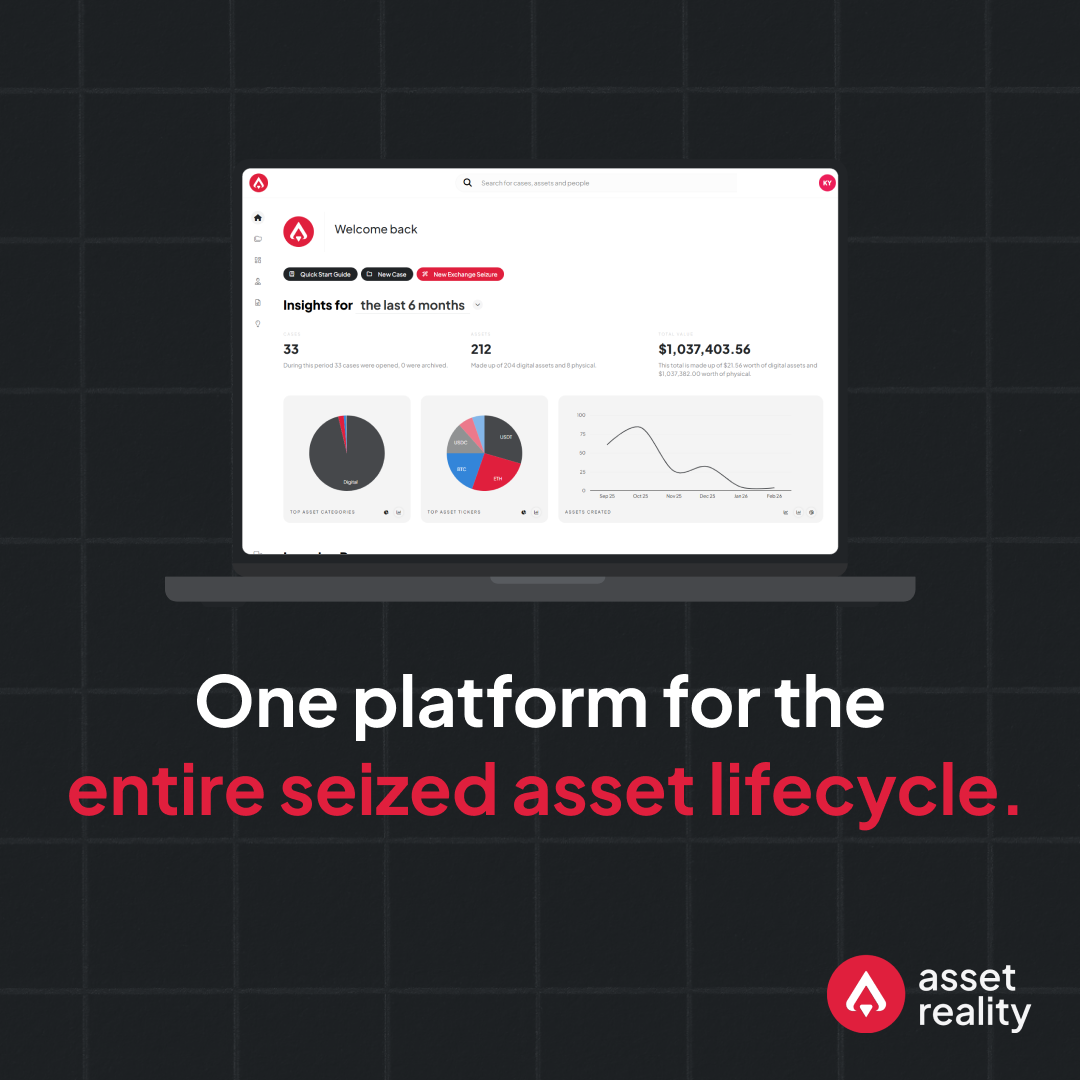
To learn more about how asset recovery practitioners and governments worldwide are using the Asset Reality platform to seize, manage and liquidate crypto following a successful investigation fill in our interest form.
To try the Asset Reality platform for yourself in our secure demo environment, fill in our demo request form.

.jpg)



.png)


.jpg)
.jpg)




.jpg)














.png)



.avif)