Seized Asset Bets: Key Trends Shaping Recovery
The seized asset sector is changing fast. Asset Reality's CSO Hugo Hoyland highlights the trends in AI, unified systems and global workflows shaping its future.


The seized asset sector is evolving rapidly, driven by the increasing sophistication of offenders, the diversification of asset types, and the operational pressures placed on government agencies to manage high‑volume, high‑variety seized property. Several key developments will shape the market over the coming years:
1. A Single Asset Recovery Operating System
Coverage Expansion beyond Traditional Cryptos
Asset-backed tokens, tokenised real-world assets, non‑fungible tokens, and digital collectibles are increasingly seen in fraud, money‑laundering, sanctions evasion, and cyber‑enabled crime. We already seize those today, and future solutions will automatically support their full lifecycle management, including:
- provenance verification,
- metadata preservation,
- integrity checks for off‑chain content and underlying assets, and
- the valuation of illiquid or non‑standard assets where no reliable market reference price exists.
A mature public‑sector platform must treat these assets not merely as transferable tokens, but as evidential artefacts, which require careful handling, documentation, and secure long‑term storage.
Integrated Management of Physical and Complex Assets (a “hard” legal requirement in the EU)
Government agencies are increasingly seeking a single unified platform to manage all seized assets - digital and physical. This includes:
- vehicles,
- cash,
- property,
- luxury goods,
- financial instruments such as shares or bonds, and
- crypto‑assets and tokens.
Consolidating these into one system eliminates fragmentation across units and reduces operational risk. The trend is towards platforms that provide consistent workflows, chain‑of‑custody tracking, reporting, and disposal processes across all asset classes, rather than standalone tools for digital assets alone.
Under Article 27 of EU Directive 2024/1260, all EU Member States are required to implement an “effective asset recovery system” for centralising seized and confiscated asset data by November 2026. This makes unified management a hard legal requirement and creates a clear expectation that physical and digital assets must sit within a single, auditable environment that supports cross‑agency access, consistent national reporting, and future‑proof compliance.
Interoperable Cross‑Border Seizure and Recovery
Crime is international, and the ability for agencies to work across borders is not a “nice to have” - it’s essential. Today, cross‑jurisdictional asset recovery is slowed by inconsistent processes, incompatible systems, manual evidence transfer, and legal uncertainty around moving digital and physical assets between authorities. The result is predictable: delays, leakage, and victims waiting years for outcomes.
We will see the creation of a global, interoperable seizure and recovery operating system - an infrastructure layer that allows agencies in different jurisdictions to coordinate in real‑time. This platform will enable:
- standards‑based data exchange,
- cross‑border authorisation workflows,
- secure transfer of digital and physical asset oversight and control,
- real‑time visibility for multinational cases, and
- transparent benefit‑sharing and victim restitution.
Once multiple agencies (police, tax authorities, judiciary, customs) from different countries operate inside one unified environment, asset recovery performance increases exponentially - not linearly.
2. AI‑Driven Automation Across Casework
Computer Vision for Asset Intake
AI‑powered image recognition will significantly reduce manual handling when cataloguing seized property. Uploading a picture of a vehicle or physical item will allow the system to automatically identify:
- make, model, and year (for vehicles),
- category and estimated value, and
- any case‑relevant characteristics.
This reduces human error, accelerates intake, and standardises data capture.
Automated Document Generation
Artificial intelligence will play a major role in automating legal and administrative drafting, including:
- affidavits,
- freezing orders,
- forfeiture applications,
- court‑ready reports, and
- compliance documents.
Rather than manually collating seizure data, chain‑of‑custody records, and valuation information, AI can combine these into structured, court‑ready documents within minutes, saving investigators and case officers significant time.
Intelligent Document Processing
AI will increasingly extract structured data from incoming:
- warrants,
- court orders,
- legal filings,
- bank records, and
- blockchain evidence.
This enables automatic pre‑population of case records and triggers the correct operational workflows without manual input, improving consistency and reducing administrative backlog.
Automated Seizure Best Practice Guides: “Common Sense” from “Uncommon Experience”
We’ve proven this time-and-time again over the last five years. When you reduce the cost, risk, and operational pain of seizing and managing assets, agencies seize more - which directly increases the value ultimately returned to victims and governments.
The constraint today isn’t a lack of assets to seize, but lack of operational capacity and institutional knowledge. Remove that bottleneck and the whole ecosystem changes.
Our clients have seized the broadest range of assets, from boats to bitcoin and from ancient papyrus to polygon. Specialised training and knowledge‑sharing for all staff involved in asset identification, tracing, recovery and confiscation is legally required, not optional, under the latest EU Directive. AI plays a critical role here: it can preserve and standardise institutional knowledge, train new staff faster, and surface the “next best action” for each asset type, ensuring every officer benefits from the collective experience of all agencies. We call these seizure best practices “common sense from uncommon experience.”
Annual Statistics and Regulatory Reporting
In the EU, Member States must compile and submit comprehensive annual statistics by 31 December each year, including:
- numbers of freezing and confiscation orders,
- estimated values at freezing and at confiscation,
- cross‑border execution requests,
- value recovered via other Member States,
- interlocutory sales, and
- value destined for social reuse.
These reporting obligations, also found in FATF Recommendations 4 and 38, are extensive, detailed and time‑consuming, and most agencies today do not have the systems required to compile them efficiently. AI can automate much of this work by:
- aggregating data across agencies,
- generating compliant statistical outputs,
- validating completeness, and
- preparing submission‑ready annual reports.
This reduces administrative burden and improves the accuracy, consistency and timeliness of national reporting.
3. Advancements in On‑Chain Infrastructure and Cost Management for All Assets
Gas Station / Fee Abstraction Models
Managing blockchain transaction fees (“gas”) across multiple chains is becoming more complex due to volatility and network fragmentation (while the regulatory trend is pushing compliant services towards less, not more, networks, bad actors are not subject to the same pressures). Fee‑abstraction models will become standard, with the platform managing:
- gas procurement (to enable seizures from addresses that don’t hold gas),
- fee optimisation,
- transaction scheduling, and
- cost controls.
This ensures seizures and disposals are never delayed due to insufficient gas or unexpectedly high fees.
Transparent and Itemised Fee Reporting
Public bodies increasingly require forensic cost transparency for court submissions and audit functions. Modern systems will therefore provide:
- itemised network fees,
- bridge/DEX fees,
- slippage and routing information,
- custody fees, and
- all associated operational costs (storage, maintenance, etc.).
Every penny associated with the realisation of an asset will be fully accounted for, supporting evidential disclosure and financial governance obligations.
4. Aligned Expectations of Operational Resilience
As jurisdictions adopt frameworks such as MiCA, DORA, and Travel Rule requirements, there will be an increased expectation that government‑sector custody solutions:
- recognise that regulatory frameworks rolled out for consumer protection (like MiCA) were not designed for those working on behalf of court-appointed processes serving a very different need,
- support agency‑specific compliance processes,
- meet emerging audit and evidence‑handling standards,
- provide transparent best‑execution reporting for disposals, and
- operate with zero conflicts of interest (governments will no longer appoint exchanges/platforms who have been subject to regulatory actions, e.g., money laundering fines, as their custodian).
Public‑sector custody will move away from consumer exchange‑based models toward sovereign‑grade infrastructure built specifically for law‑enforcement and asset‑recovery workflows.
Conclusion
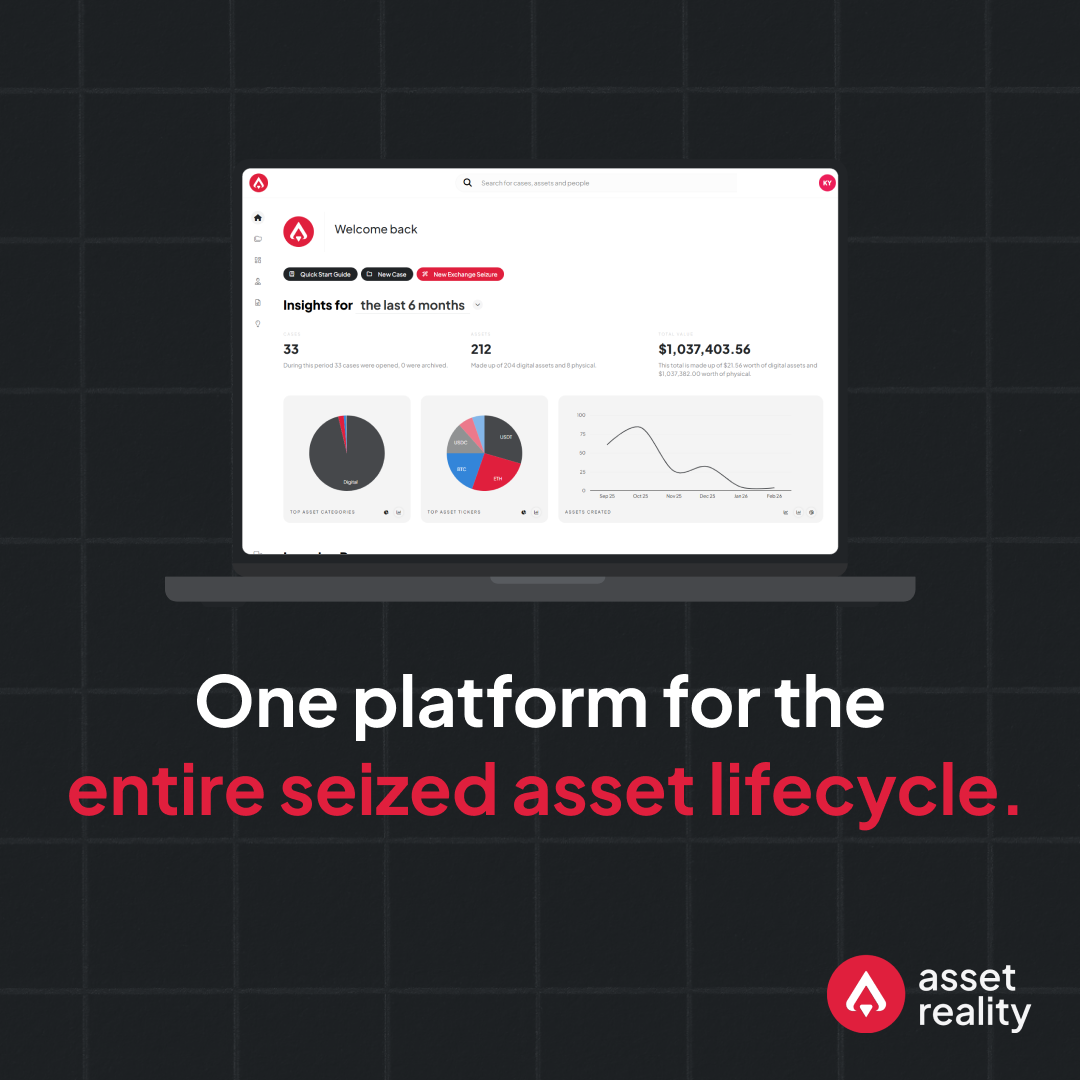
The future of seized‑asset management will be shaped by agencies adopting infrastructure built specifically for the realities of enforcement, not repurposed from consumer markets. That future isn’t theoretical - it already exists. Asset Reality's Platform was designed from day one to meet the exact needs of those working with seized assets across digital, physical, and complex categories. It is the only system in the world built and operated by a team whose sole focus is solving this problem end‑to‑end.
Our technology has already supported more than 1,500 seizures and facilitated close to $1 billion in seized‑asset transactions, giving us unparalleled operational insight into what works, what fails, and what enforcement agencies truly need. That experience is embedded directly into the workflows, resilience standards, and best practices that power our Platform today.
As the sector accelerates toward unified operating systems, AI‑driven automation, sovereign‑grade custody, and cross‑border interoperability, we’re not speculating about where the market is heading - we’re building it. And we’re doing so alongside the agencies, regulators, and practitioners who will rely on this infrastructure for the next decade of asset recovery.

.jpg)



.png)



.jpg)
.jpg)



.jpg)













.png)



.avif)