What if no asset were ever left behind? Key takeaways and practitioner perspectives
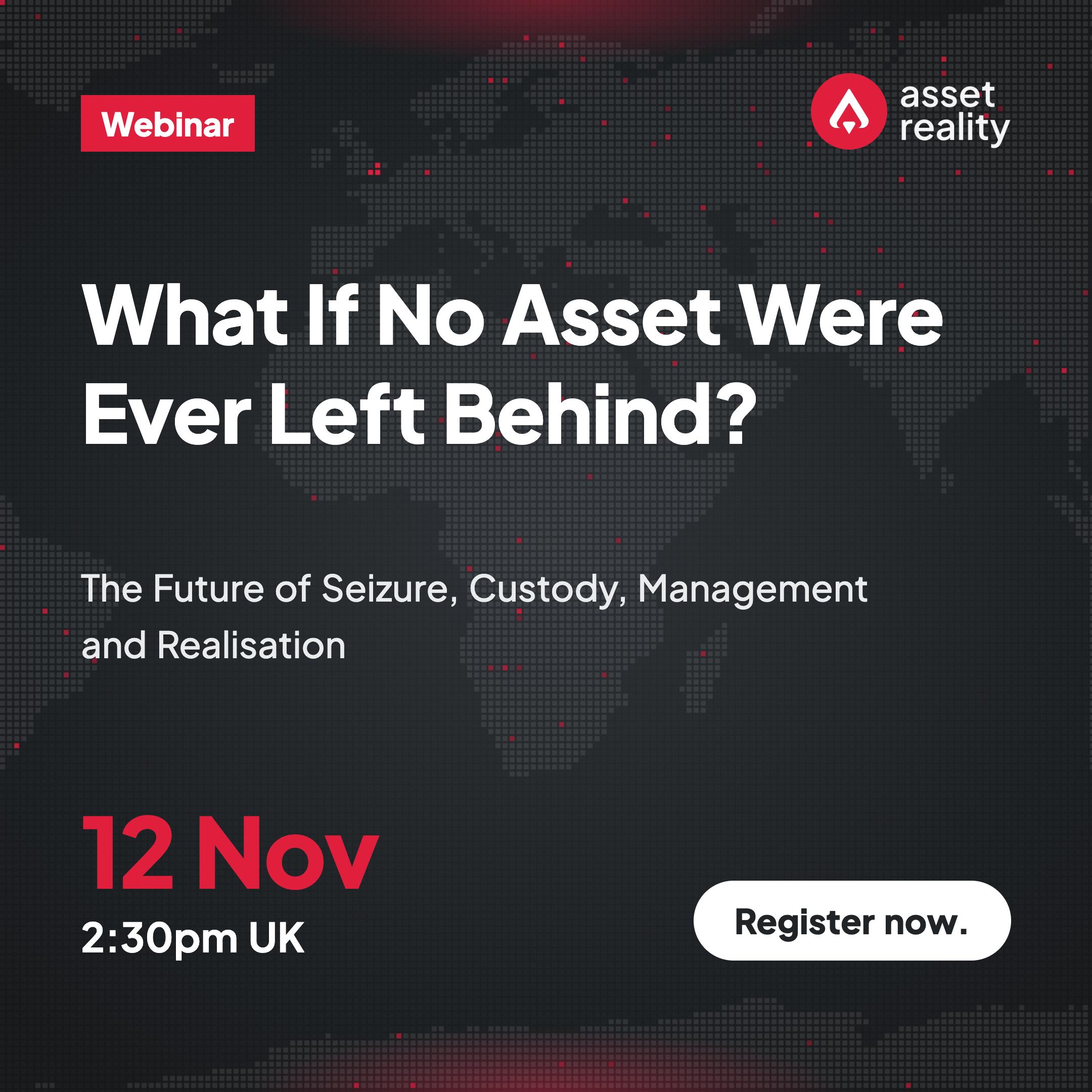
What if no asset were ever left behind? In our latest webinar, we looked at where assets slip through the gaps across seizure, custody, management and realisation.

On 12 November, Hugo Hoyland (Co-Founder and Chief Operating Officer), Nicky Lawrence (Chief Product and Technology Officer) and Chrissy Hill (Chief Legal and Risk Officer) asked a simple question: what if no asset were ever left behind?
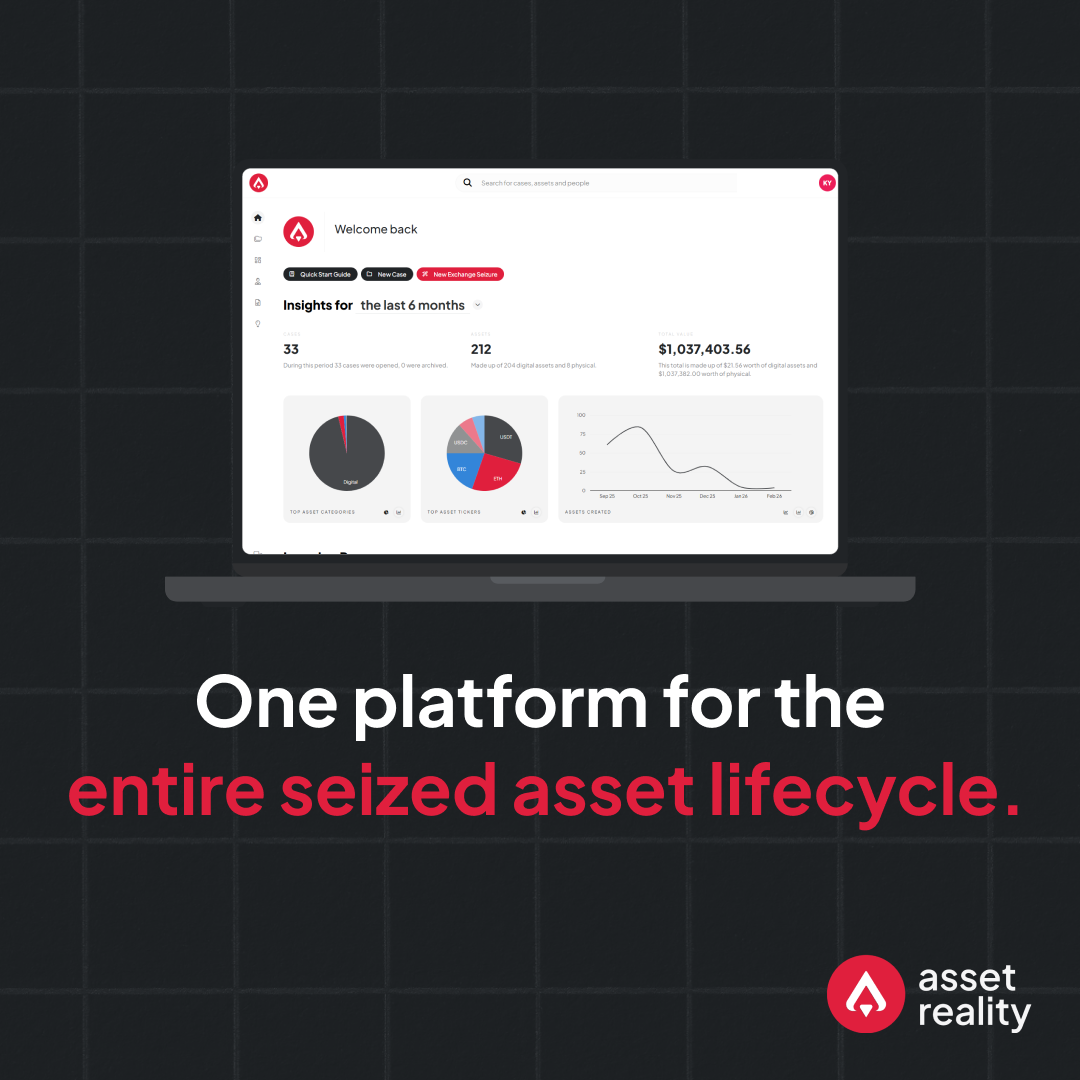
They looked at where assets slip through the gaps across seizure, custody, management and realisation; heard from practitioners in Jamaica, the Caribbean and the U.S. on the challenges they experience; and shared the enterprise Platform we're building to help.
Watch the full recording on the Asset Reality Academy.
The scale of the gap
Crime is hard to measure, and seizures are harder still. UNODC estimates that illicit markets and money laundering account for roughly 2 to 5% of global GDP. Even at the low end, that would make crime the third largest economy in the world, behind only the U.S. and China.
Yet, the last meaningful EU study, a 2016 Europol report, found that between 2010 and 2014 only about 2.2% of criminal proceeds were seized or frozen, and around 1.1% were ultimately confiscated. Those figures predate the wider use of digital assets, and no comparable study has been done since.
Taken at face value, the drop from 2.2% to 1.1% suggests that half of seized assets are returned to defendants, yet agencies tell us their return rates are far lower than that. Much of the gap is value lost while assets wait for a final decision, making preservation of value during management one of the biggest challenges in the lifecycle. Meanwhile, the 98% that is never seized is reinvested in further criminal activity, and the problem compounds year on year.
Where assets get left behind
Chrissy set out the four stages of the asset lifecycle, and where assets can slip through at each one:
- In criminal hands: Investigators and prosecutors work to identify proceeds of crime, whether digital, financial or physical, as they are moved, layered and hidden.
- Freezing: Banks, exchanges and other holders block assets under a freezing or restraint order so they can't be moved.
- Seizure: Assets come under the agency's control, and the record becomes essential: what the asset is, who holds it, and under what authority.
- Realisation: On court order, assets are realised and the proceeds return to victims or the public purse.
Assets can be left behind at every one of these stages, and each handover between them is a point of risk. A record that follows every asset, physical or digital, through every handover and decision is what makes the outcome defensible.
What "no asset left behind" means
For Chrissy, ‘no asset left behind’ comes down to one test: can we account for the asset? Most of us can track a £20 parcel to our door, yet assets worth millions are still often recorded on spreadsheets, email chains and hardware wallets. The risk sits in those handovers. Every handover is a point of risk. Earlier this year, prosecutors in South Korea found that around 320 seized Bitcoin had gone missing, and it only came to light five months later during a staff handover. As Chrissy put it, trust comes from truth: a record that holds at every handover, for every decision.
Nicky described it as a promise that practitioners should never have to leave something on the table because their tools let them down. For Hugo, it's about the society we choose to live in. When fraud victims can’t get their money back, trust in institutions erodes. When crime rarely gets caught and pays well, criminals have every reason to carry on. Asset recovery is one of the few levers that can change both.
Practitioner perspectives
We heard directly from practitioners in Jamaica, the Caribbean, and the U.S. about what seizing and managing assets looked like before a central system.
In Jamaica, Dennis Chung, Chief Technical Director of the Financial Investigations Division, explained that their asset database lived in spreadsheets, so they needed a user-friendly system that could act as a single repository for every asset and its information.
For the Regional Security System (RSS), which supports 8 member states across the Caribbean, each law enforcement agency kept its own records, making it difficult to follow assets from seizure through to disposal.
Ken Scott of the Spokane County Sheriff’s Office described having to wait for a sergeant to open the safe before reviewing his own virtual asset cases. With each case on a separate cold storage device, it was hard to see what colleagues were working on, and even harder to supervise and report.
Today, all three use Asset Reality’s enterprise Platform to manage every asset in one place. That shared view means each case can be followed from seizure to disposal across agencies, with every action recorded for audit and reporting purposes.
Watch the practitioner highlights to hear more in their own words.
Giving time back: Asset Intelligence
Nicky told the story of four watches seized from a single address in the UK, which took more than 16 hours of planning and data entry to complete. Scaled across the 4,760 restraint and confiscation orders made in England, Wales and Northern Ireland during the last financial year, that’s more than 75,000 hours, or 43 years of work!
The people doing this work are some of the most capable investigators and asset managers in the world. They deserve tools built for the job, especially when the people they’re up against can move money in minutes.
That’s why the next phase of our platform, Asset Intelligence, is designed to give that time back:
- Before the seizure: instead of a week of calls and emails, our planning tool works through what you’re seizing, what it will cost to hold, and whether it’s worth seizing at all, giving you a robust plan you can put in front of a supervisor or a court.
- On the day of seizure: hours of data entry become a quick review. An officer can upload a handwritten list and site photos, then generate, check and sign off complete asset records in minutes, with all data kept within your jurisdiction.
- After the seizure: ask your records questions in real time to see which assets are costing more to store than they’re worth, and act before value is lost.
For our four watches, Asset Intelligence turns 16 hours of admin into minutes, giving practitioners more time to focus on what matters: getting money back to victims.
Fast In. Slow Out.
Hugo then turned to the philosophy behind our ‘Fast In. Slow Out.’ custody infrastructure. Virtual assets need to come into secure custody quickly, and leave it only through layered, accountable approvals.
Fast in: FATF calls for seizures to be carried out expeditiously, so agencies need to be able to take any asset into custody quickly when it counts. That depends on people with the right training, processes that preserve evidential integrity, and technology that takes on the manual work. Across the 50+ agencies in 20 countries using our enterprise Platform, we see a common adoption curve. Programmes often start with one crypto specialist doing everything. They scale as that knowledge spreads and generalists can handle routine seizures with guided workflows, leaving specialists free to tackle the more complex cases.
Slow out: Once assets are in custody, the priority shifts to protecting them until a final decision is made. For virtual assets, the risk lies with whoever controls the keys or seed phrase. Exchanges keep those keys online so assets can move quickly, which suits trading but leaves seized assets exposed. Our Platform’s layered governance means named individuals initiate and approve every movement, with further checks to guard against internal and external fraud. No single person can move assets alone, and neither can Asset Reality.
For Kisha Sutherland, Director of the RSS Asset Recovery Unit (RSS ARU), a central system like this lightens member states' compliance burden and improves coordination across the region.
Help shape what we build next
As a purpose-built platform, Asset Reality is shaped by the people who use it, so we want to hear what your team needs to seize and manage every asset, and where you'd like us to focus next. Get in touch to share your thoughts.
You can revisit the full session on the Asset Reality Academy, or book a discovery call to talk through how your team manages seized assets today and where our enterprise Platform could help.